


Table of Contents
Here is something strange.
A company will spend €250,000 on a conference.
It will fly in 300 people, rent a beautiful venue, build a stage, rehearse the CEO and convince customers to say smart things in public.
Then it will hire a video crew two weeks before the event with this brief:
“Please film the keynote and make a two-minute highlights video.”
That is nuts.
For one or two days, the company has gathered its best customers, smartest employees, most credible experts and biggest stories in one place.
It has accidentally built a media company.
Then it produces one recap video that everyone forgets by Friday.
Recent developments in corporate video, event technology and professional photography suggest that this old model is finally breaking.
The new model is simple:
Your event is not just an experience. It is a temporary content studio.
Here is what changed in the last two weeks.
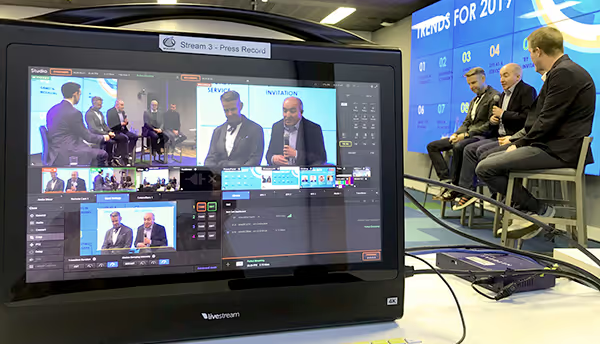
1. The conference room is turning into a broadcast studio
On July 12, AVIXA published an analysis with a wonderfully blunt premise:
The brief says “conference room.” The client expects “broadcast studio.”
That gap is getting bigger.
More than 13,000 corporate media professionals attended NAB Show 2026. That was nearly double the 2025 number.
NAB is traditionally a broadcast show. The people arriving now are not only television engineers. They are internal communications teams, event producers, corporate video managers and marketing departments.
Why?
Because the quality bar has moved.
Your audience does not compare your corporate stream with another corporate stream. They compare it with Netflix, YouTube, podcasts, TED Talks and professional live broadcasts.
They may not know what bad colour balance is. They absolutely know when something feels cheap.
They notice when:
- The speaker sounds like they are inside a bathroom.
- The presentation cannot be read on a phone.
- The camera shows an empty stage while someone speaks off-screen.
- The livestream fails during the one announcement people came to see.
- The lighting makes the CEO look like a witness in a crime documentary.
Cameras, sound, lighting, switching, streaming and distribution have to work together.
This changes the first question marketers should ask.
Do not begin with:
“How many cameras do we need?”
Begin with:
“What must this event produce?”
That answer determines everything else.
2. A major event company just put $100 million behind this shift
Encore recently announced a $100 million commitment to event technology and production products for 2026.
The shopping list is revealing.
It includes:
- Multilingual live captioning.
- Transcription and session summaries.
- Modular LED environments.
- Upgraded audio for small and midsize rooms.
- Tools for visualising event spaces before production begins.
- Faster ways to create speaker introductions and branded content.
- Systems designed to extend event value after people leave.
Encore’s announcement was also included in BizBash’s July event technology report.
The obvious interpretation is that event technology is getting fancier.
I think that misses the point.
Encore is betting that event content is becoming infrastructure.
Captioning is not a nice bonus at the end of production. It is part of the live experience.
Translation is not a separate post-production project. It is part of international distribution.
Session summaries are not merely notes for attendees. They can become sales follow-ups, internal reports and raw material for future marketing.
Even Encore’s investment in audio tells us something.
Audio is not sexy. Nobody posts a photograph of a perfectly positioned column speaker on LinkedIn.
But bad audio destroys an event faster than almost anything else.
A simple stage with excellent sound feels professional.
A €100,000 LED wall with terrible sound feels like an expensive mistake.
3. Production automation is becoming useful
On July 14, Matthew Davis of PTZOptics described a problem familiar to smaller production teams.
One operator may now be expected to manage:
- Multiple cameras.
- Audio.
- Graphics.
- Recording.
- Streaming.
- Presentation feeds.
- Remote speakers.
- Technical support.
- Content distribution.
This is where automation is beginning to help.
Auto-framing can keep a presenter composed correctly.
Voice tracking can follow a panel discussion.
Software can flag potential moments for replay.
Production systems can warn an operator that something needs attention.
But there is a catch.
Automation is not a producer.
It does not know that the nervous customer in the front row has just heard the result they were waiting for.
It does not understand when the audience reaction is more important than the person on stage.
It does not know that a pause is powerful.
It cannot reliably compensate for terrible lighting, poor audio or badly positioned cameras.
The July 14 analysis argues that successful teams are not trying to automate everything. They are choosing one repetitive production problem and solving it properly. .
This gives event managers a useful test for any production technology.
Ask three questions:
- What specific job does this automate?
- Under what conditions does it fail?
- What is the human backup?
If the supplier cannot answer those questions, you are probably watching a demonstration rather than buying a dependable production system.
4. “This is a real photograph” is becoming a valuable claim
On July 8, the International Press Telecommunications Council published a practical guide to C2PA Content Credentials.
This sounds technical. The business idea is simple.
Content Credentials can attach signed provenance information to a photograph or video. They may show where an asset originated and what happened to it during a compatible editing process.
They do not magically identify every fake.
The information can also be lost when files pass through platforms that strip metadata.
Still, Canon, Leica, Nikon, Sony and major publishers are already supporting the technology.
This will matter outside journalism.
Think about the corporate photographs that companies publish:
- Factory and facility photographs.
- Executive portraits.
- Sustainability projects.
- Investor events.
- Scientific or medical documentation.
- Public affairs campaigns.
- Product launches.
- Images from politically sensitive locations.
For years, marketers mainly asked:
“Does this photograph look good?”
The next question may be:
“Can we prove where it came from?”
That creates a new type of premium corporate photography service.
The photographer does not merely deliver polished images. The photographer preserves a trustworthy chain between the real event, the camera, the editing process and the final published asset.
For most event galleries, this may be unnecessary.
For regulated industries, ESG communications, investor relations and public affairs, it could become very valuable.
The big opportunity: stop buying videos and start building a content system
Most event briefs are lists of deliverables.
One highlights video.
Fifty edited photographs.
Three interviews.
A recording of the keynote.
That is better than nothing. But it begins too late.
A smarter brief starts with the content journey.
Ask:
- What needs to be published while the event is happening?
- What does the sales team need the next morning?
- Which speakers can become useful experts on LinkedIn?
- What will help promote next year’s event?
- Which customer statements could support a sales conversation?
- Which assets need to work horizontally and vertically?
- Which material must be translated?
- Which photographs need documented provenance?
- What should still be producing value six months later?
Then design the shoot.
Steal this three-part delivery plan
During the event
Deliver:
- Speaker and audience photographs.
- Approved sponsor images.
- Short backstage interviews.
- One or two vertical clips.
- Livestream or remote viewing feeds.
- Press-ready images for important announcements.
The goal is not to publish everything instantly.
The goal is to prevent the marketing team from posting blurry phone photographs because the professional gallery will not arrive for five days.
Within 24 hours
Deliver:
- A curated press gallery.
- Executive and speaker portraits.
- A short vertical recap.
- A widescreen highlight video.
- Clean footage of major announcements.
- Selected interview clips with captions.
This gives marketing, sales and communications teams something useful while the event is still relevant.
During the following week
Deliver:
- Complete sessions.
- Edited customer interviews.
- Sales enablement clips.
- Recruitment content.
- Thought leadership videos.
- Sponsor packages.
- A searchable archive with useful metadata.
This is where the event begins earning back its production budget.
Multi-city events have an even bigger opportunity
International companies often make one of two mistakes.
They fly the same production team around the world at enormous cost.
Or they hire unrelated local crews with completely different briefs and receive footage that does not match.
There is a better option.
Create one international production standard.
Define:
- Resolution and frame rates.
- Audio specifications.
- Interview framing.
- Lighting expectations.
- File names.
- Colour approach.
- Required photographs.
- Release forms.
- Transfer deadlines.
- Metadata.
- Vertical and horizontal deliverables.
- Backup procedures.
Then use capable local crews in each city.
The cameras do not need to be identical.
The output does.
A team in Amsterdam, Singapore, New York and São Paulo can create one consistent campaign if everyone is working from the same production system.
The uncomfortable truth
Most companies do not have a shortage of content.
They have a shortage of useful content.
They have hard drives full of:
- Ninety-minute panel discussions nobody will watch.
- Photographs of people standing beside branded walls.
- Keynote recordings with poor sound.
- Interviews without a clear question.
- Generic highlight videos filled with handshakes and coffee cups.
The answer is not to film more.
The answer is to know why you are filming before the first camera arrives.
That is the shift behind these recent announcements.
Corporate events are becoming media operations.
The winners will not be the companies with the largest screens, the most cameras or the most aggressive automation.
They will be the companies that recognise valuable moments and build a system for capturing, verifying and distributing them.
Planning a corporate event or international production series? Get Camera Crew provides camera operators, photographers and production teams around the world, coordinated through one consistent production brief.



.svg)