

Table of Contents
The best event recap videos do not try to show everything that happened. They select the moments that communicate an event’s purpose, energy and value and make the viewer wish they had been there.
That might mean a fast 35-second highlight reel created for LinkedIn. It could be a two-minute conference film combining keynote speakers, venue details and attendee reactions. For an event built around ideas or customer stories, it may be a longer, interview-led video that continues delivering value after the venue closes.
Below are six event recap video examples filmed by Get Camera Crew. Together, they demonstrate how B2B brands can transform live events and business moments into useful marketing content.
What is an event recap video?
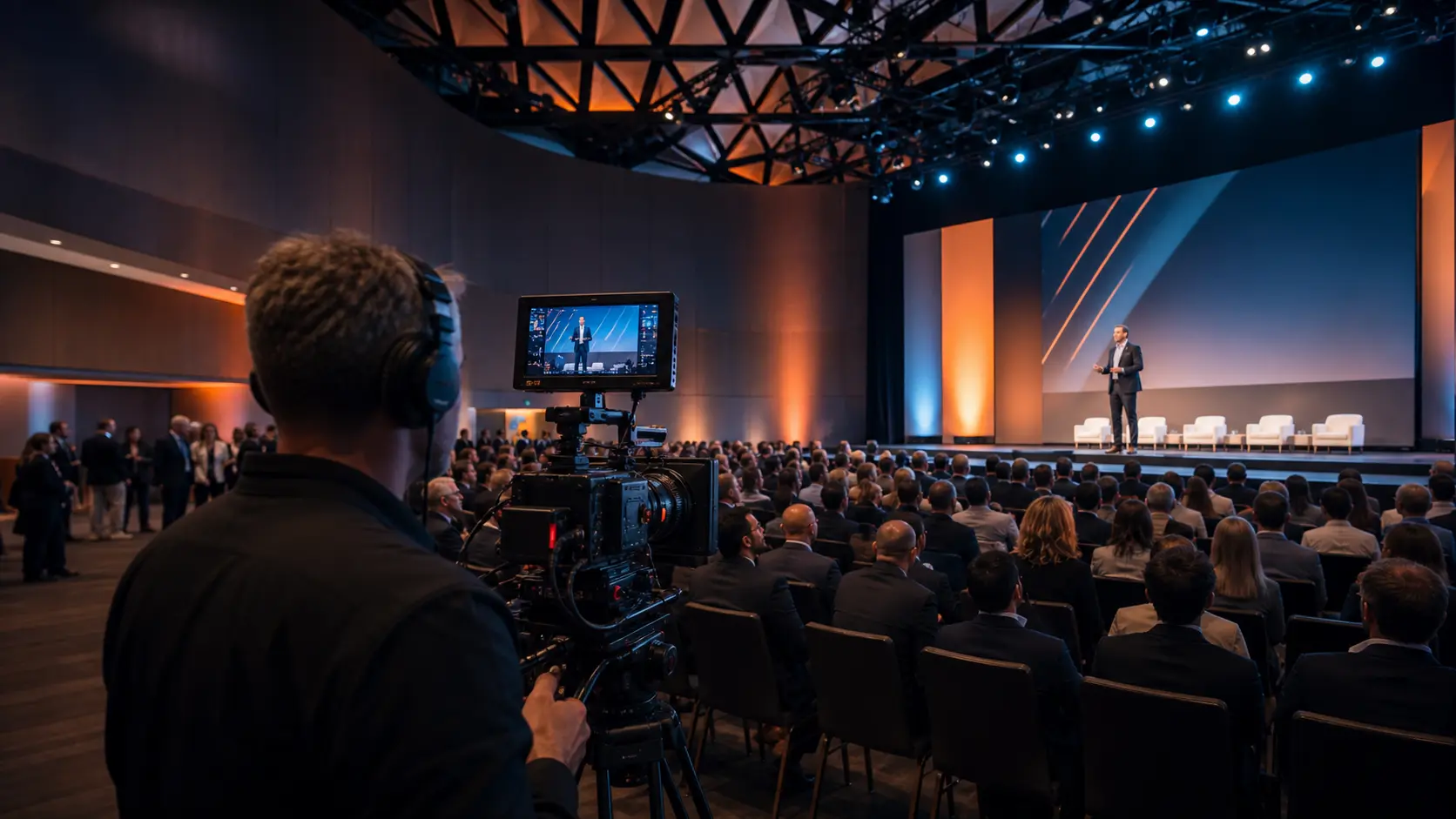
An event recap video is a short edited film that captures the most important moments from a conference, summit, trade show, corporate gathering or brand activation.
It usually combines:
- Venue and establishing shots
- Keynote speakers and panel discussions
- Audience reactions
- Networking and candid interactions
- Branded installations and event details
- Interviews with speakers or attendees
- Music, graphics and selected sound bites
Its purpose is not to provide a complete record of the agenda. A successful recap should quickly answer three questions:
- What happened?
- Why did it matter?
- Why should the viewer attend, follow or engage next time?
For many B2B events, a 60-to-120-second hero film provides enough time to establish the setting, show the people and create a clear impression. Short social edits can run for 30 to 60 seconds. Interview-led recaps may need two to four minutes when the ideas expressed at the event are as important as its atmosphere.
1. Mastercard Summit: a cinematic event recap
The Mastercard Summit film is a strong example of a premium B2B event recap. In under two minutes, it establishes the location, presents the scale of the production and moves between stage content, brand installations and recognisable details such as the UEFA Champions League trophy.
The visual identity remains consistent throughout. Red and orange lighting, architectural shapes and bold stage graphics make the event feel unmistakably Mastercard without requiring a heavy voiceover or lengthy explanation.
Why it works
- The opening establishes a distinctive visual world immediately.
- Wide shots communicate the scale and production value of the summit.
- Speaker footage proves that the event contained meaningful content.
- Branded details make the film useful for internal and external marketing.
- The edit creates a sense of prestige without becoming a chronological report.
What to learn from it
Use the event’s visual identity as part of the story. Lighting, screens, architecture, signage and smaller branded details can make a recap feel cohesive even when it covers many different moments.
2. Hipther Prague: a community-led conference recap
The Hipther Prague recap begins outside the venue and follows attendees into the event. That simple progression gives the film a natural structure: arrival, participation, conversation and shared experience.
Rather than focusing exclusively on the stage, the camera spends time with delegates. People enter the venue, talk over coffee and connect between sessions. Badges and environmental details provide context, while candid interactions demonstrate the value of being in the room.
Why it works
- The exterior opening creates a clear beginning and sense of place.
- Moving shots make viewers feel as if they are entering the event.
- Networking footage shows the community instead of simply claiming one exists.
- A modern colour grade supports the technology-focused atmosphere.
- The mixture of people, spaces and programmed content prevents visual repetition.
What to learn from it
At a B2B conference, the conversations between sessions can be as persuasive as the sessions themselves. Capture genuine exchanges, introductions and reactions—not only speakers standing on a stage.
3. Amazon FAST forward: an interview-led event recap
Amazon FAST forward takes a different approach. At more than three minutes, it has room to explain what the event was about, not just what it looked like.
Keynote material, branded motion graphics, exhibition footage and on-camera interviews work together to build a story around transportation and sustainability.
The interviews give the edit authority. Instead of relying entirely on music and montage, people at the event explain why the subject matters to their organisations. Subtitles keep those insights usable when viewers watch without sound.
Why it works
- The opening identifies the event and its central theme quickly.
- Speaker excerpts add substance and context.
- On-site interviews turn attendees and partners into credible voices.
- Branded backgrounds connect the interview shots to the event.
- Captions improve comprehension and silent viewing on social platforms.
What to learn from it
Record several concise interviews during the event. One strong answer can anchor the main recap and later become a standalone social clip, customer story or sales asset.
4. GIRO: a 35-second social event recap
The GIRO film demonstrates how little time a recap needs when its objective is simple: show where the event happened, establish its professional quality and provide a burst of highlights.
The video moves from an exterior establishing shot to stage coverage and close speaker moments. At 35 seconds, there is no room for a detailed explanation—and none is needed.
Its concise structure makes it suitable for LinkedIn, paid social media, a post-event email or a quick proof point on an event landing page.
Why it works
- The first shot immediately establishes the venue.
- The edit reaches the main event action quickly.
- Speaker close-ups create a stronger human connection than wide shots alone.
- The short runtime makes the video easy to watch and reshare.
What to learn from it
Match the runtime to the distribution channel. A focused 30-to-45-second edit will often work better when the objective is fast social reach rather than detailed storytelling.
Beyond the highlight reel
A highlight reel does not need to be the only asset created from an event shoot.
If customer, employee or executive interviews are planned in advance, the same production can generate longer videos that remain useful after the immediate post-event campaign ends.
The next two examples are not conventional event recaps. They demonstrate how interview-led storytelling can extend a content plan beyond the highlight reel itself.
5. Porcher Industries: turning interviews into an evergreen customer story
The Porcher Industries and Cornerstone film is closer to a customer story than an event highlight. It uses polished interviews, workplace context, exterior footage and cinematic establishing shots to explore innovation and employee development.
This format is valuable for B2B teams because it prioritises expertise and evidence. A short recap may generate immediate excitement, while a longer customer story can support sales conversations, recruitment, internal communications and thought leadership for months.
Why it works
- Interview subjects carry the narrative in their own words.
- Establishing shots create scale and professional context.
- Multiple locations prevent a longer interview film from feeling static.
- The story connects people, business strategy and organisational value.
What to learn from it
If customers or executives will already be together, treat access to them as a content opportunity. Schedule dedicated interviews and capture relevant B-roll rather than expecting polished answers from rushed conversations on a noisy show floor.
6. Celebrating Our Superheroes: a people-led campaign film
Produced around International Women’s Day, this Amazon Logistics film uses an extended interview format to place personal experience at the centre of the story.
Clean interview composition, branded name graphics and captions allow the subject’s perspective to lead.
Like the Porcher example, this is not a traditional event montage. It demonstrates a useful alternative when a campaign moment is about people and ideas rather than crowd energy. The longer runtime provides space for nuance that would be lost in a 60-second highlight reel.
Why it works
- A clearly framed interview builds trust and keeps attention on the speaker.
- On-screen identification establishes the subject’s credibility.
- Subtitles make the story accessible and social-friendly.
- Branded graphics connect an individual story to a wider campaign.
- The human perspective gives the content a longer useful life.
What to learn from it
Do not force every piece of event-related content into the same fast-paced format. When the message depends on lived experience, leadership or customer proof, let the interview breathe and create shorter extracts separately.
What the best event recap video examples have in common
The examples above vary in length and tone, but the strongest share several production principles.
They establish identity immediately
The viewer should understand the event’s world within the opening seconds.
A distinctive venue, bold stage visual, recognisable speaker or genuine human moment is usually more effective than a slow logo animation.
They capture scale and detail
Wide shots prove attendance and production value. Close-ups reveal expressions, gestures, badges, products and branded details.
A strong edit moves between both perspectives.
They show people participating
Empty rooms and immaculate stages may look polished, but people create the event’s value.
Capture arrivals, conversations, questions, demonstrations, applause and moments of concentration.
They have a purpose beyond documentation
Before filming, decide what the recap needs to accomplish.
It may need to:
- Promote next year’s conference
- Demonstrate sponsor value
- Support sales follow-up
- Attract future attendees
- Position the organisation as an industry leader
- Provide content for social media
That goal should determine the shot list, interview questions, runtime and call to action.
They are planned before the event
A strong recap cannot be created entirely in the edit.
The production team needs the agenda, venue plan, speaker list, brand guidelines and priority moments in advance. If interviews are required, the subjects and suitable recording locations should also be organised before the event begins.
How long should an event recap video be?
There is no single correct length. Choose the shortest format that can achieve the video’s objective.
15–45 seconds
Best for:
- Immediate social posts
- Paid advertising
- Event teasers
- Instagram and LinkedIn clips
60–120 seconds
Best for:
- The main event recap
- Website and landing-page videos
- LinkedIn campaigns
- Promoting the next event
Two to four minutes
Best for:
- Interview-led recaps
- Communicating event themes
- Customer and sponsor perspectives
- Internal communications
Four to eight minutes
Best for:
- Customer stories
- Employee profiles
- Leadership interviews
- Evergreen campaign content
One production can provide several versions. A two-minute hero recap might also generate a 30-second teaser, vertical social cuts, speaker clips and a longer interview film.
Essential shots for an event recap video
A practical B2B event shot list should normally include:
- Venue exterior and location details
- Registration, arrivals and badges
- Event signage and branded installations
- Wide shots of the stage and audience
- Medium and close shots of keynote speakers
- Panels, demonstrations and breakout sessions
- Audience reactions, note-taking and applause
- Networking and candid conversations
- Sponsor areas, products and exhibitor activity
- Short interviews with speakers, customers and attendees
- Closing moments and a visual call to action
The final shot list should reflect the event’s business objective.
A customer summit may prioritise testimonials, while a product launch needs demonstrations and audience reactions. A leadership conference may require clean excerpts from the keynote.
How to use a recap after the event
An event recap becomes more valuable when distribution is planned before filming.
The finished video and its shorter edits can be used across:
- LinkedIn posts from the company, executives and speakers
- Post-event email campaigns
- The registration page for the next event
- Sponsor reports and partnership presentations
- Sales follow-up with attendees and target accounts
- Internal communications and leadership updates
- Recruitment and employer-brand channels
- YouTube, Vimeo and the company’s content library
Whenever possible, plan a package rather than one finished film. Capturing the event once and editing for several channels is more efficient than returning to production whenever the marketing team needs another asset.
Choosing the right event recap style
Choose a cinematic recap when the venue, scale and brand experience are the main story.
Choose a community-led recap when networking, participation and belonging are the reasons people attend.
Choose an interview-led recap when the event is built around expertise, transformation or customer outcomes.
Choose a short social recap when speed, reach and easy sharing matter most.
Choose a long-form follow-on story when access to customers, employees or leaders can produce evergreen content with value beyond the event itself.
Frequently asked questions
What is the difference between an event recap and an event highlight video?
The terms are often used interchangeably.
A highlight video usually emphasises energy, emotion and memorable visuals. A recap may provide more context through speaker excerpts, interviews or a clearer account of the event’s themes.
Many B2B videos combine both approaches.
Should an event recap include interviews?
Not always, but interviews add context and social proof.
They are particularly useful when the audience needs to understand what attendees learned, why the topic matters or what makes the event worth attending next time.
Can one camera operator film an event recap?
One experienced operator can cover smaller events when the schedule and shot priorities are clear.
Larger conferences, simultaneous sessions or projects requiring complete presentation recordings usually benefit from multiple cameras, dedicated sound support and a producer coordinating coverage.
How quickly should an event recap be delivered?
For time-sensitive social campaigns, a short teaser may be edited during the event or delivered shortly afterwards.
A polished hero recap takes longer because the footage must be organised, selected, edited, mixed, colour-corrected and reviewed. The deadline and approval process should be agreed upon during pre-production.
Can event footage be repurposed into other content?
Yes.
Keynotes can become speaker clips, interviews can become testimonials, and strong quotes can support social posts, sales follow-up and written articles.
Planning those outputs before the event helps the crew capture the right footage and audio.
Turn your next event into more than one video
The right recap gives an event a life beyond the room.
It can remind attendees why the day mattered, show non-attendees what they missed and provide your marketing team with credible visual content for the next campaign.
Get Camera Crew provides event video production and conference video production through a global network of local production professionals.
We can help with planning, filming, interviews, photography, editing and delivery, whether you need one concise highlight or a complete library of event content.
Explore our video portfolio or send us your event date, city, agenda and required deliverables to receive a tailored quote.

.avif)


.svg)