
%20(1).avif)
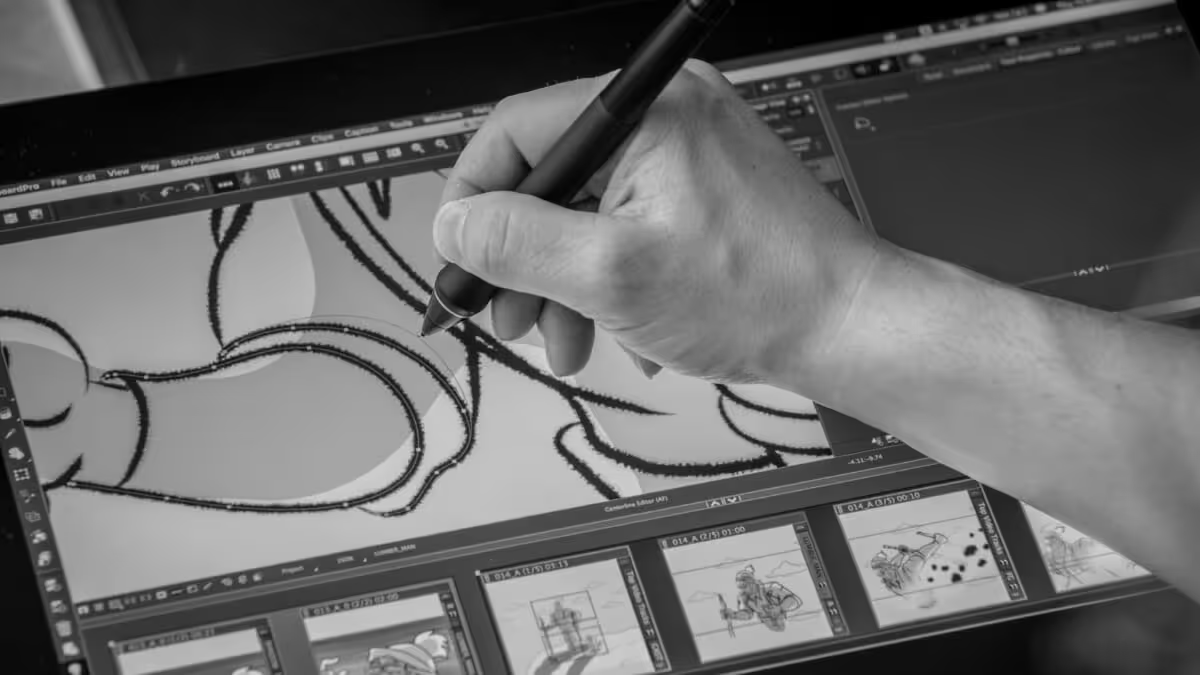
Table of Contents
Quick answer: A storyboard artist visualizes a script as a sequence of drawn frames showing what each shot will look like. Storyboards bridge the script and the shoot, giving the director, DoP, and crew a shared visual reference before any cameras roll. The role is distinct from a concept artist (who builds visual mood and design) and an animator (who creates moving images). Day rates for an experienced storyboard artist in Western Europe range from 400 to 1,200 EUR per day, with most projects charged as flat fees.
What a storyboard artist actually does
A storyboard is the visual plan for a production. It shows each shot, the framing, the camera angle, the action in frame, and the relationship between shots. It is part planning document, part creative blueprint.
A working storyboard artist is responsible for reading and understanding the script, breaking the script into individual shots with the director, drawing each frame (typically as quick sketches, though some productions need polished color storyboards), capturing camera angle, framing, lens choice indication, subject position, and key action in each frame, annotating frames with shot numbers, scene numbers, dialogue beats, camera movement notation, and timing, revising through director and producer feedback, and delivering the storyboard in a format the production team can use on set (PDF, digital tool export, printed shot books).
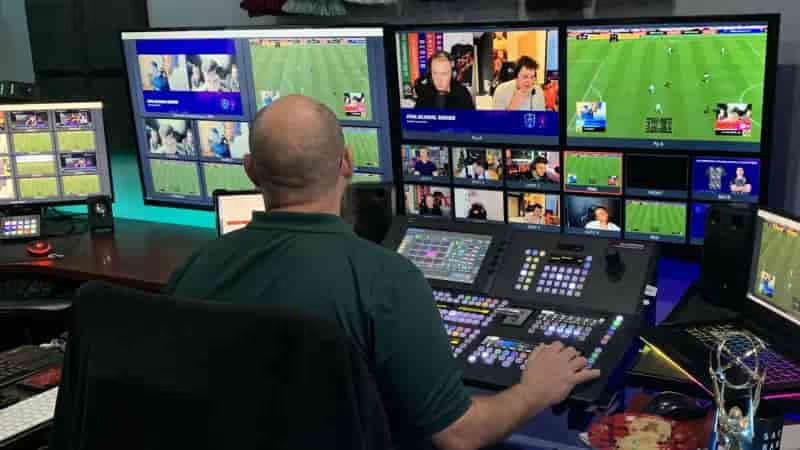
For B2B corporate productions, storyboards are most common on explainer videos, animated content, brand films with significant visual treatment, complex multi-camera live broadcasts, and pharma webinars with stringent visual compliance requirements.
Types of storyboarding for B2B corporate work
Rough storyboards (thumbnails)
Quick black-and-white sketches showing each shot. Used early in pre-production to lock the shot list and shooting plan. Most common form of B2B storyboarding. Can be done in a day or two for a 60-second explainer.
Detailed storyboards
More polished drawings with greater detail in characters, environments, and lighting. Used for brand films, premium product launches, and any production where the visual treatment is part of the creative pitch.
Color storyboards
Full-color rendered frames showing exactly how each shot will look. Used for high-end commercials, premium brand films, and any production where the client needs to approve the visual before committing to production. Significantly more time-consuming.
Animatics
Storyboards edited to match the script timing, often with rough VO or temp music. Used for animation and motion graphics work where pacing needs to be approved before final animation begins.
Shot lists with reference imagery
For live-action shoots where full drawn storyboards are not needed, a shot list with reference imagery (existing photos or stills from films matching the desired look) often serves the same purpose. Faster and cheaper.
Software and tools
Modern storyboard artists use a mix of traditional and digital tools.
- Storyboard Pro (Toon Boom): industry standard for animation storyboarding. Powerful but expensive.
- Storyboarder (Wonder Unit): free open-source tool popular for indie and B2B work.
- FrameForge: 3D-based storyboarding for accurate spatial planning.
- Procreate plus iPad: increasingly common for rough storyboards. Fast and flexible.
- Photoshop or Krita: for color polished storyboards.
- Boords, Studio Binder, Milanote: web-based tools combining storyboarding with shot lists, scripts, and collaboration features.
Storyboard artist versus animator versus concept artist
The storyboard artist visualizes a script as a sequence of shots. Their output is a static visual plan.
The animator creates moving images, either 2D or 3D. They often work from a storyboard, not the script directly.
The concept artist creates the visual identity, characters, environments, and design language for a production. They work earlier than storyboarding, often before scripts are locked.
On smaller productions, one person handles all three. On larger productions they are separate hires with different craft specializations.
Day rates and project fees
Storyboard artists usually charge by the project or per frame rather than by the day.
- Per-frame pricing (rough): 15 to 40 EUR per frame for quick black-and-white
- Per-frame pricing (detailed): 50 to 150 EUR per frame for detailed work
- Per-frame pricing (color): 100 to 300 EUR per frame for color storyboards
- Day rates: 500 to 1,200 EUR per day in Western Europe for full-day work
- Project rates for typical 60-90 second explainer storyboard: 600 to 3,000 EUR
- Project rates for 3-5 minute brand film storyboard: 2,000 to 8,000 EUR
When you need a storyboard
You need a storyboard when:
- The production includes animation, motion graphics, or VFX work that needs to be approved before production
- Multiple stakeholders need to align on the visual treatment before committing to shooting
- The shoot involves multiple locations or scenes that need clear shot-by-shot planning
- The script is complex enough that text descriptions are insufficient for the crew
- The production budget is large enough to warrant the investment in planning
- The director and client need a visual reference document for the shoot
You probably do not need a full storyboard when:
- The shoot is a simple talking-head interview or single-camera testimonial
- The visual treatment is largely improvised on the day
- The script is simple enough that a written shot list suffices
- The budget cannot accommodate the investment
For most B2B corporate work, a written shot list with reference imagery serves the storyboard function at lower cost.
Get a storyboard artist for your next production
Get Camera Crew has been sourcing storyboard artists and full visual development teams for 38 years across more than 45 countries. Our storyboard and visualization work supports explainer videos, brand films, training, and pharma webinar projects for clients including AWS, Kaspersky, AstraZeneca, and Alcon.
To discuss your storyboard or visual planning needs, request a proposal or download our Corporate Video Cost Guide.
.avif)



.svg)